


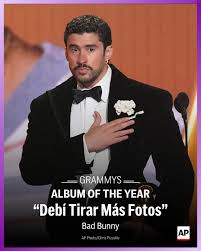
At the 68th Annual Grammy Awards on February 1st, 2026, Bad Bunny made history by winning the award for Album of the Year for his Album Debí Tirar Más Fotos. This moment was especially significant because it marked the first time that a completely Spanish-language album won the most prestigious award of the night. For decades, the Grammys were mostly dominated by English-language music, which often made it harder for international artists to receive the same level of recognition. Bad Bunny’s win symbolized a major change in the music industry. It showed that music does not need to be in English to connect with audiences around the world. Millions of Spanish-speaking fans felt proud seeing their language and culture represented on one of the biggest stages in music. His victory also demonstrated how much Latin music has grown in global influence over the past decade, becoming one of the most streamed and celebrated genres worldwide.
During his acceptance speech, Bad Bunny did more than simply thank the people who helped him create the album. He took the opportunity to talk about larger issues affecting Latino communities, especially immigrants and people who often feel ignored or misunderstood in society. He spoke about the importance of remembering where you come from and respecting the struggles that many families face when they move to a new country searching for opportunity. His words reminded the audience that behind the music are real people and real experiences. By bringing attention to these topics during such a major event, he showed that artists can use their platform to speak up about social issues and encourage others to think more deeply about fairness and respect. The speech made the moment even more powerful because it turned a personal achievement into something that represented millions of people.
Only a short time after his Grammy victory, Bad Bunny continued making history when he headlined the halftime show at Super Bowl LX, one of the most watched television events in the world. Being chosen to perform at the Super Bowl halftime show is already considered one of the highest honors in entertainment, but Bad Bunny’s performance carried an extra layer of meaning. He became one of the first Latino solo artists to headline the show on his own, which was a huge milestone considering the event’s massive global audience. Instead of changing his style to appeal to a wider audience, Bad Bunny stayed true to his roots by performing in Spanish and highlighting elements of Puerto Rican culture throughout the show. This decision itself was a message, showing that Latino artists do not have to change who they are in order to succeed on the biggest stages.
The performance included strong visual symbolism connected to Puerto Rico, the island where Bad Bunny was born and raised. Throughout the show, Puerto Rican flags appeared across the stage, and many of the dancers wore outfits inspired by Caribbean culture. The stage design and visuals also referenced moments in Puerto Rico’s history, including struggles the island has faced after natural disasters such as Hurricane Maria. By including these elements, Bad Bunny reminded viewers that Puerto Rico has a rich culture but has also experienced hardships that many people around the world may not fully understand. Instead of ignoring those realities, he used the halftime show to celebrate resilience and pride. The performance mixed high-energy music with meaningful cultural references, creating a moment that was both entertaining and powerful.
Another important message Bad Bunny tried to send during the halftime show was about how the idea of “America” is larger than just the United States. Through visuals, music choices, and cultural references, he highlighted how the Americas include all the countries across North America, Central America, and South America, and the Caribbean. At different moments in the show, flags and colors representing Latin American cultures appeared, reminding viewers that millions of people across these regions share connections through language, history, and traditions. His performance suggested that America is not just one country but two continents made of many nations and cultures. By presenting this idea on such a huge stage, he encouraged people to think about the Americas as a shared community rather than something divided by borders.